Cape Town offers lowest monthly bill, best services for 2025_26
23 April 2025
The City of Cape Town offers the lowest monthly municipal bill of South Africa’s ‘big five’ metros. This is based on an analysis of the 2025/26 tabled budgets for each metro across a range of water and electricity usage scenarios for properties under R5 million. See the full analysis: https://bit.ly/44kmGCV.
‘This analysis shows that even after the proposed 2025/26 increases are taken into account, Cape Town still offers the lowest total municipal bills of all major cities based on proposed rates and tariffs for properties under R5 million, along with the most functional services and largest infrastructure investment programme. While Cape Town delivers value for money in a functional, working city, the exact opposite is happening in other metros where residents are paying more and more for broken services and collapsing infrastructure,’ said Cape Town Mayor Geordin Hill-Lewis.
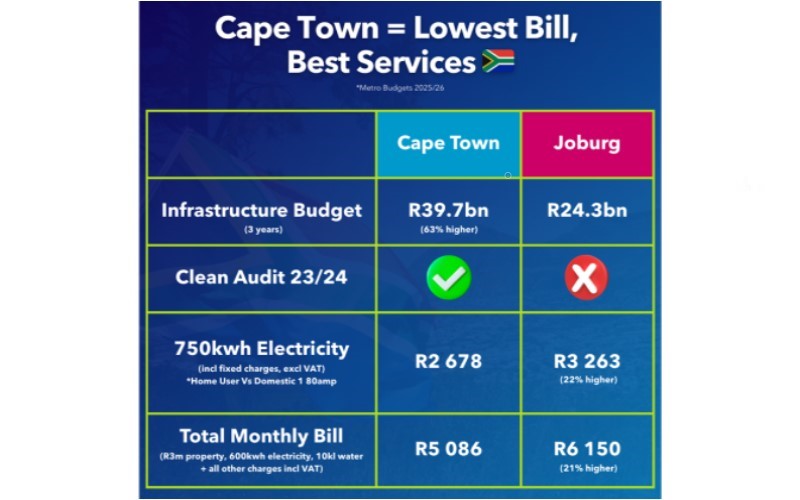
‘Monthly bills are significantly lower in Cape Town despite the City investing 63% more in infrastructure than Joburg over the next three years, with a South African record R39,7bn infrastructure budget that will see better roads, water, sanitation, electricity and community infrastructure for our city,’ said Mayor Hill-Lewis.
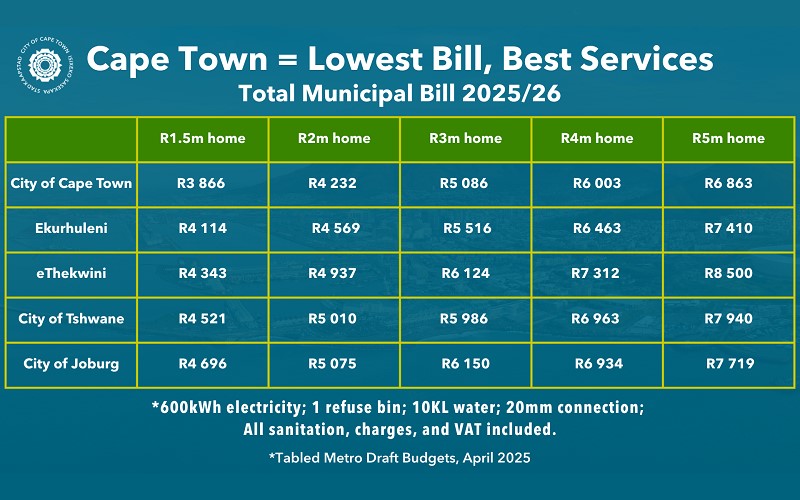
When comparing common consumption scenarios of 10-30kl of water, and 600-850kWh of electricity for properties under R5m, Cape Town’s total municipal bill is lowest in each scenario compared to other major cities including all rates, charges and VAT.
Based on these common consumption scenarios, monthly municipal bills for Cape Town households are significantly lower than their Johannesburg counterparts:
- R1,5m home: R500 – R800 lower
- R3m home: R740– R1060 lower
- R5m home: R530 – R850 lower
While it is often raised that there is a considerable difference in property values between Cape Town and other cities, even when adjusting for a 25% higher property value in Cape Town, a R2.5m Cape Town home still comes out with an over R700 lower bill than a R2m home in Johannesburg based on 2025/26 rates and tariffs for each city.
Electricity increase just 2% in Cape Town
All households in Cape Town will benefit from a much lower electricity increase of just 2% compared to Eskom’s 11,32% increase to municipalities nationwide for 2025/26.
This price relief will especially benefit higher consumption households, with those under R2m using 750kWh or more (and 10-30KL water) seeing total municipal bill decreases of as much as -3% including all rates and charges, with increases generally limited to around 3,5% depending on consumption levels.
The linking of water and sanitation fixed charges to the property band (rather than meter connection size) further contributes to the extensive relief for residential properties valued under R2m.
Meanwhile, households using 1500kWh per month (and between 10-30KL of water), will see total municipal bill increases of around 3-5% for a R3 million property, 6–8% for a R4m property, and around 9 – 10,5% for a R5m property, including all rates and charges.
This is made possible by discontinuing the 10% cost of each electricity unit to fund other City services, such as area cleaning.
Instead, City-wide cleaning services will be funded by a ring-fenced tariff, the impact of which is buffered by the savings in electricity costs. This reform is aligned with the broader National Treasury-led Trading Service Reform Programme, which has a key objective, within the waste management space, to ensure services are sustainably funded via ring-fenced tariffs, as with other utility services.
Cape Town’s progress in this regard puts the metro in line for Treasury’s new performance incentive grant, and a share of the performance-based R54bn available over six years which can go to further infrastructure investment and enhancements to the service.
Lowest property rates
Cape Town’s ratepayers further benefit from the lowest property rates of South Africa’s metros for commercial, industrial, and residential property rating categories based on the rate-in-Rand rate, a statutory formula used by municipalities to calculate property rates.
The next metro, Johannesburg is 42% higher for commercial and industrial property rates, and 33% higher for residential property rates.
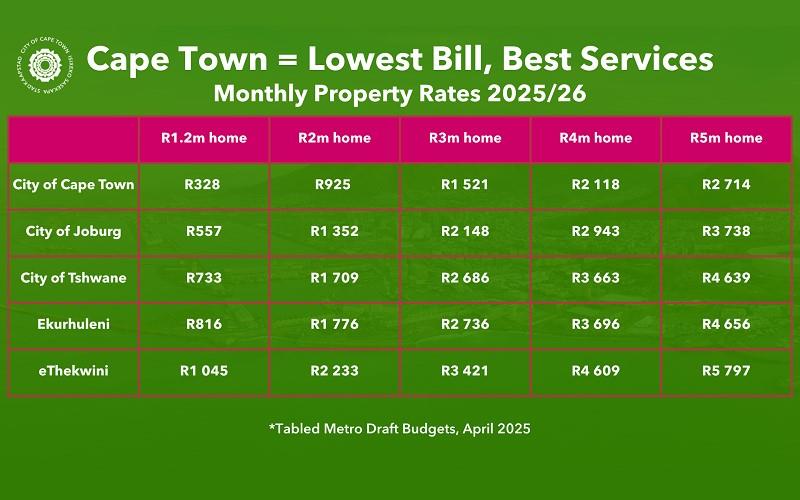
The first R450 000 of a property’s value is also rates-free for properties valued under R5 million in Cape Town, the highest relief of its kind in South Africa, compared to the first R300 000 being rates-free in Johannesburg.
2025-26 Rate in Rand - Residential
- Cape Town – 0,007159
- Johannesburg – 0,009545
- Tshwane – 0,01172
- Ekurhuleni – 0,011520
- Ethekwini – 0,014254
2025-26 Rate in Rand - Commercial
- Cape Town – 0,016824
- Ekurhuleni – 0,023050
- Johannesburg – 0,023862
- Tshwane – 0,02929
- Ethekwini – 0,036234
2025-26 Rate in Rand - Industrial
- Cape Town – 0,016824
- Johannesburg – 0,023862
- Ekurhuleni – 0,028810
- Tshwane – 0,02929
- Ethekwini – 0,047200
Most inclusive social package
For 2025/26, Cape Town has also tabled the most inclusive social assistance package for indigents and pensioners, including:
- Highest Free Water allocation to indigent customers (15kl)
- Widest qualifying criteria for 100% rates relief (R450 000 property value, <R7 500 monthly income)
- Widest qualifying criteria for lifeline electricity (R500 000 property value, <R7 500 monthly income)
- Pensioners: widest rates rebate and lifeline electricity criteria (<R22 000 monthly income, regardless of property value)
Cape Town also has the highest levels of residents benefitting from free basic services, according to StatsSA’s latest non-financial census data for municipalities released on 27 March 2025.
‘Our Invested for Hope budget also contains the country’s biggest ever pro-poor infrastructure investment, with 75% of our record R39,7bn budget set to directly benefit lower-income households. Over the next three years, these investments alone will create around 130 000 construction-related jobs.
‘With SA’s lowest unemployment rate, Cape Town is already the city where a person is most likely to find a job, and we plan to do much more to grow our economy in the years to come to the benefit especially of lower-income households,’ said Cape Town Mayor Geordin Hill-Lewis.
End
Published by:
City of Cape Town, Media Office